Rescued Sailors Express No Remorse
An Australian father and son ignored weather warnings, requiring U.S. Coast Guard rescue in New England.
The U.S. Coast Guard began warning New England boaters about the incoming storm a couple of days before it hit. On Friday, February13, USCG issued a weather warning about “a storm to take seriously.” The next day, USCG personnel flew more than 700 miles up and down the projected track of Mother Nature’s wrath, trying to get as many boaters as possible out of harm’s way. They used phrases like “severe blizzard conditions,” “gale and storm warnings,” “potentially damaging winds,” “gusts of over 60 knots.” The seas, they warned, could easily swell to 20 feet.
Reg and Jason McGlashan remained unfazed, and they cast off their lines nonetheless.
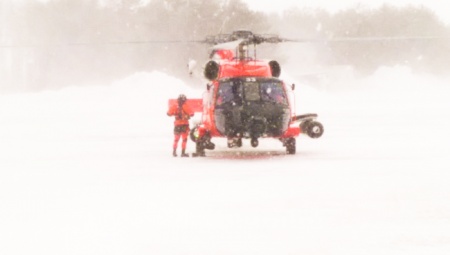
A Coast Guard Air Station Cape Cod helicopter crew returns from rescuing a father and son from a sailboat about 150 miles south of Nantucket. (U.S. Coast Guard photo contributed by Coast Guard Air Station Cape Cod)
Maybe the local media hype had something to do with their zeal. Just a week earlier, the father-and-son duo had been on the front page of The Newport Daily News, talking about how Jason, age 37, had spent $10,000 on eBay in October 2014 to acquire a 20-year-old, 43-foot sailboat called Sedona. He and his 66-year-old father, Reg—a retired financial broker with little to no sailing experience—were going to cruise her some 8,600 nautical miles to their native Australia, where Jason thought he could break the record for a solo sail around the island nation. They’d stowed flares, flotation devices and, according to Jason, lots of food and booze. He told local reporters that he believed everything would be fine.
Another reason they may have ignored USCG storm warnings was fear of future weather on the other side of the planet. Jason told NBC News he didn’t want to get caught later, well off the coast of Australia, in the Southern Ocean’s winter storms. Better to be closer to land if there’s going to be a disaster, he reasoned.
Yet another wrinkle in trying to determine why they sailed out, with an incoming blizzard, is that the USCG may have told them they could outrun the weather. Jason told the Cape Cod Times that local Coast Guard officials inspected the Sedona and gave the McGlashans the okay to set sail on Friday, February 13—the same day USCG issued a weather warning about the incoming storm.
Whatever the truth (neither Jason McGlashan nor the USCG responded to requests for comment), the McGlashans set off from Conanicut Marina in Jamestown, Rhode Island, on a path that would put them, just two days after the first USCG warning went out, right in the eye of the nasty New England storm. By the time their sails tore, their engine failed and they called for help about 150 miles south of Nantucket at 4:50 a.m. on February 15, the seas were 9 feet and building with 40-mph winds. A few hours later, when they jumped from their hard-rolling boat into the 43-degree water to reach the metal rescue basket of a USCG MH-60 Jayhawk helicopter, seas were 25 feet and winds were nearly 60 mph, and still building.
Conditions were deteriorating to the point that the Jayhawk was the only rescue craft able to launch from Coast Guard Air Station Cape Cod, and its crew had to battle near-hurricane-force winds to reach the Sedona. Ice and low visibility prevented an HC-144 Ocean Sentry support plane from leaving the ground.
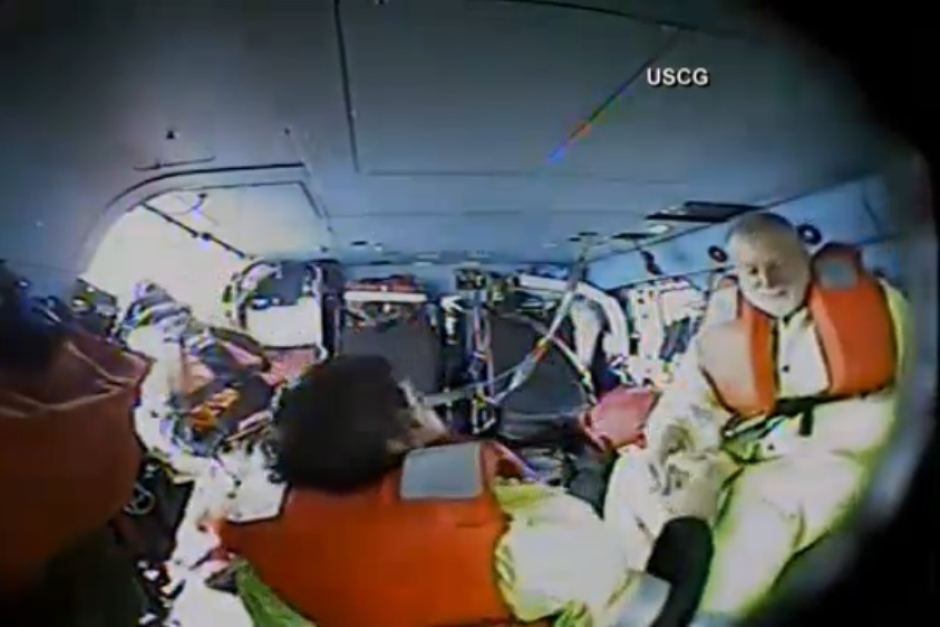
Seas were 25 feet and winds were nearly 60 mph when the McGlashans were pulled to safety.
“Given the severity of this storm, this rescue was a major effort, and we are all relieved it ended as it did,” Lt. j.g. Tyler Dewechter, MH-60 pilot and public affairs officer at Air Station Cape Cod, stated in a press release. “We are glad we were prepared for this storm and could render aid—and also continue to urge mariners to stay safe and heed the cautions and advisories of winter storm warnings.”
How much does such a rescue effort cost American taxpayers? In July 2013, Coast Guard Sector Columbia River in Oregon stated that it cost $8,000 for an MH-60 Jayhawk along with a 25-foot response boat to perform a four-hour search after a hoax call. The rescue of the McGlashans began with USCG receiving a call at 4:50 a.m. and ended with the men landing at Air Station Cape Cod at 10:50 a.m., a total of six hours. So $8,000 is probably a low-end guess.
And are the McGlashans sorry? It doesn’t appear so. While Jason McGlashan did commend the USCG crew for being utmost professionals, he also stated after the rescue that he indeed could have outrun the weather if not for failures on the boat. In fact, he was cracking jokes for the media after being treated for mild hypothermia. When asked if his father also needed treatment, he told the Cape Cod Times, “He has enough fat on him to keep him warm.”